

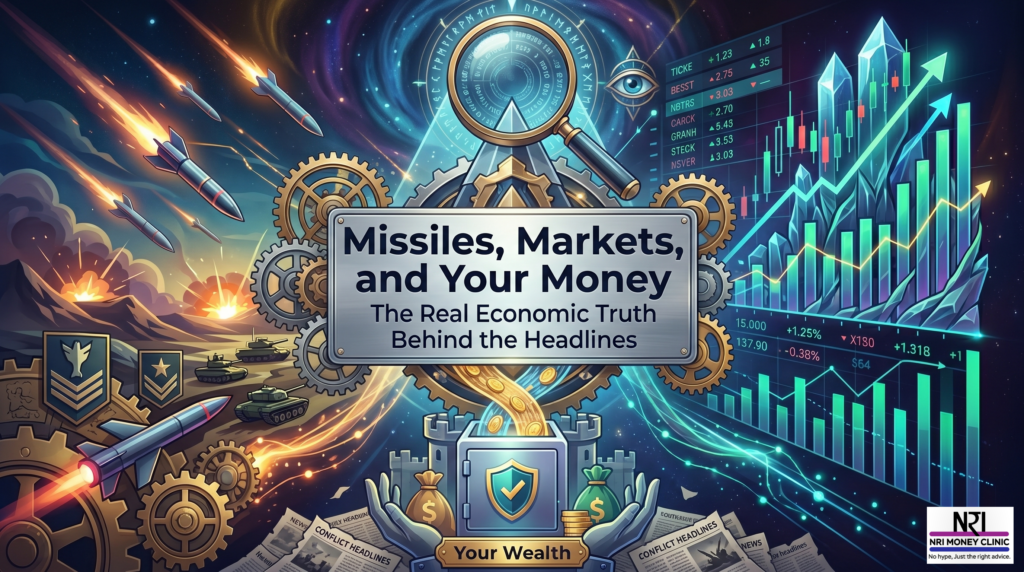
You turn on the news, and it looks like a blockbuster movie you never bought a ticket for. Missiles are flying, alliances are drawing lines in the sand, and the economic tremors are being felt from Wall Street to Dalal Street.
It begs the ultimate, terrifying question: Are we in the middle of World War III?
Before we let panic dictate our financial decisions, let’s take a step back. To understand where we are going, we need to dissect where we have been. Let’s look at the brutal economic lessons of the past century, decode the current global standoff, and figure out exactly how smart investors should be playing this.
The Ghosts of World Wars Past
The world has survived massive global conflicts before, but they always come with a hefty economic receipt.
World War I (1914-1918) Triggered by an assassination and fueled by rising nationalism, this four-year conflict dragged in over 30 countries and cost over 20 million lives. But what happened to the money?
The Power Shift: Global dominance formally shifted from Europe to the USA.
The Economic Hangover: Economies drowned in insurmountable debt. Uncontrollable inflation and post-war diseases (like the Spanish Flu) eventually paved the way for the Great Economic Depression a decade later.
World War II (1939-1945) Born out of the preceding depression and political instability, this war involved over 70 countries and an unimaginable death toll of 70 to 85 million.
The Market Reaction: Unsurprisingly, global markets crashed initially.
The Rebound: However, the massive post-war effort to reconstruct shattered infrastructure triggered one of the greatest economic booms in history, firmly establishing the US as the undisputed global superpower.
The Middle East Chessboard: A Different Kind of War
So, how does today’s standoff between the US, Israel, and Iran compare?
For a conflict to be a true “World War,” multiple countries must be directly involved. Right now, the battlefield is geographically restricted to the Middle East, but make no mistake: the economic consequences are spilling over every border on earth.
Why? Because the center of this war is Oil, the absolute lifeblood of the global economy.
Furthermore, it’s not just about energy. The world heavily relies on the Middle East for fertilizer supplies. If vital maritime chokepoints like the Strait of Hormuz remain blocked for more than three months, we are not just looking at a fuel crisis; we are staring down the barrel of a global food shortage and severe agricultural disruption within the year.
Why This Isn’t WWIII (But It Sure Feels Like It)
Despite the clear alliances forming—the US and Israel on one side, with Iran quietly backed by Russia, China, and potentially others on the other—this is not World War III. Here is why:
Contactless Warfare: Troops aren’t marching across borders to conquer physical land. Today’s wars are fought via flying missiles, cyber-attacks, controlled narratives, crippling economic sanctions, and blockades.
Nuclear Deterrence: Unlike the mid-20th century, nuclear capabilities are distributed across NATO, the US, Russia, China, and others. Mutually assured destruction is keeping the conflict from escalating into a full-scale holocaust.
Economic Interdependence: The world is a tightly woven village. You cannot simply cut off Chinese manufacturing or Indian labor without immediately suffocating the West. This mutual reliance acts as a massive braking system on total global war.
The Dawn of a New World Order
While we might avoid a literal World War, the geopolitical landscape will never be the same.
The era of a unipolar world—where the US could act as the undisputed global “bully” without consequence—is ending. We have seen lower-cost warfare tactics bring massive military machines to a frustrating stalemate. The unquestioned aura of the US military is fading, and countries in the Middle East are beginning to question the value of hosting foreign bases.
As the geopolitical influence of the US slowly declines (much like Great Britain after WWI), a new titan is emerging: Asia. With younger demographics, massive labor forces, cutting-edge technology hubs, and ravenous consumer markets, the power pendulum is definitively swinging toward nations like India and China.
The Investor’s Survival Guide
If you are an investor watching your portfolio bounce around like a heart monitor, take a deep breath. Here is your reality check:
Expect Prolonged Volatility: The markets will swing. Prices will drop one day and spike the next. This isn’t a one-month blip; this volatility could last for many months, or even a couple of years.
Patience is Your Superpower: Wars initially disrupt, then they destroy, but eventually, they reconstruct.
The Golden Window: Do not let fear push you to the sidelines. This period of turbulence is actually a golden opportunity to onboard yourself into the market at reasonable valuations.
Stay disciplined, stick to your SIPs, and position yourself to ride the next massive bull run when the dust finally settles.
Ready to bulletproof your portfolio against global volatility? Let’s build a financial strategy that thrives, no matter what the headlines say.
Click here to chat with our expert wealth team on WhatsApp: https://wa.link/q8rw62





No comment yet, add your voice below!