

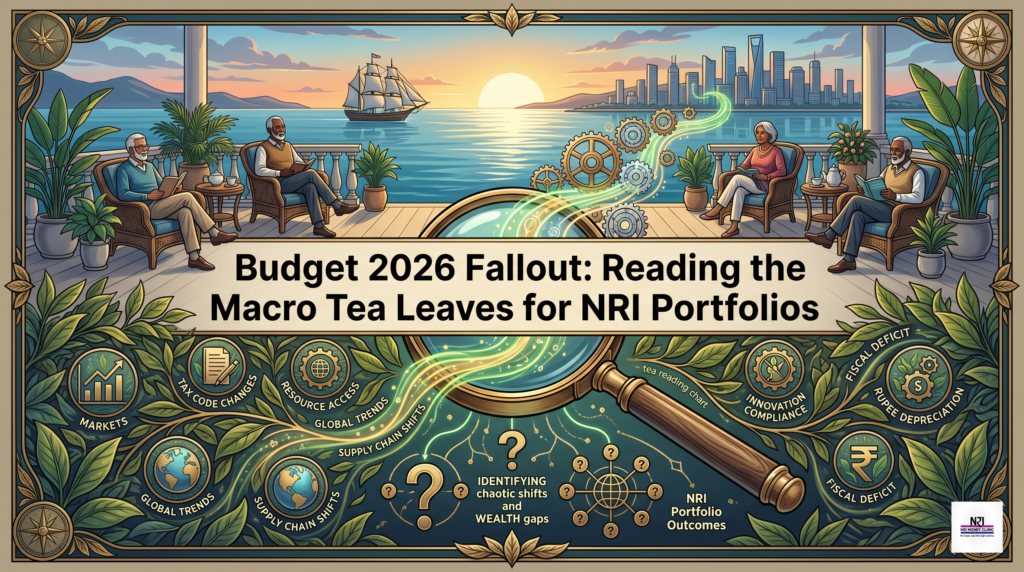
The February budget day hype is a distant memory; the financial news anchors have moved on to new topics, and we are now deep into the reality of the new financial year.
For the average resident Indian, the budget usually boils down to a brief panic over income tax slabs. But for Non-Resident Indians (NRIs) managing wealth across borders, decoding the Union Budget is an ongoing exercise in reading macroeconomic tea leaves.
Now that we are halfway through the year, the policies announced in February aren’t just theories anymore—they are actively moving markets, impacting the Rupee, and triggering tax events. If you are an NRI trying to figure out how the fiscal reality of 2026 is actually impacting your wealth right now, let’s skip the heavy economic jargon.
Here is your pragmatic, mid-year look at the macro trends you need to act on to future-proof your portfolio for the rest of the year.
1. The Capex Push: The Money is Now Moving
Back in February, the government announced massive capital expenditure (capex) plans. Now, in July, we are actually seeing those funds hit the ground. Capex announcements are the ultimate cheat code for equity investors because they tell you exactly which sectors, like defense, infrastructure, or green energy, are receiving structural tailwinds.
The NRI Play: If your Indian mutual funds or direct equity portfolios are still heavily skewed towards outdated or stagnant sectors, you are missing the boat. Mid-year is the perfect time to rebalance. Aligning your investments with the government’s active capex execution is one of the safest ways to ride the growth of the Indian economy.
2. The Currency Conundrum: The Rupee’s Mid-Year Reality
Whenever a budget is announced, global markets hyper-focus on the fiscal deficit (how much the government needs to borrow). High borrowing leads to inflation, putting pressure on the Indian Rupee (INR). By July, we are seeing exactly how the Rupee is behaving under this macroeconomic weight.
The NRI Play: A depreciating or volatile Rupee is a double-edged sword. On one hand, your foreign currency (USD, GBP, AED) goes much further today, giving you incredible purchasing power to buy Indian assets at a discount. On the other hand, it eats into the absolute value of your existing Indian portfolio. To hedge against this currency risk effectively, NRIs must look at cross-border asset allocation, such as utilizing dollar-denominated GIFT City investments.
3. The Tax Web: The Traps are Now Active
The taxman always gets his due, and since the new financial year started in April, the new rules are officially active. Budgets frequently tweak capital gains tax structures, surcharge rates, and Tax Deducted at Source (TDS) rules for NRIs.
The NRI Play: Ignorance is not bliss; it’s expensive. A minor tweak in TDS regulations can quietly lock up your capital or reduce your effective yield when you aren’t looking. If you are planning to repatriate funds, sell property, or cash out mutual funds in the second half of 2026, you must have a crystal-clear understanding of your active tax liabilities to avoid a rude awakening from the income tax department.
4. The Real Estate Ripple Effect
Real estate remains a darling asset class for the global Indian. Budgetary allocations for affordable housing, changes to REIT (Real Estate Investment Trust) taxation, or adjustments to long-term capital gains benefits have a slow but heavy impact on brick-and-mortar investments.
The NRI Play: Now that the dust has settled, we can see how the real estate market is responding. If the budget heavily incentivized commercial infrastructure, it might be time to look beyond traditional residential properties and explore REITs or commercial real estate funds. Conversely, if compliance has tightened, holding onto a stagnant physical property from thousands of miles away might be more trouble than it’s worth.
The Bottom Line: Don’t Let Your Portfolio Collect Dust
Budgets will come and go, but structural, strategic financial planning is what actually builds generational wealth.
If your portfolio is currently running on autopilot, or worse, if you haven’t adjusted your strategy since the budget was announced, it’s time for a mid-year professional recalibration. You need a strategy that turns macroeconomic policy into a personal financial advantage.
Ready to align your global investments with the mid-year realities of 2026? Let’s build a shock-proof plan together.
📲 Click here to chat directly with our expert wealth team on WhatsApp: https://wa.link/q8rw62






No comment yet, add your voice below!